If you have recently purchased a Google Pixel device in Pakistan, you already know the struggle of finding authentic accessories. Walk into any major tech market whether it is Hafeez Center in Lahore or Saddar in Karachi and you will be overwhelmed by sellers offering “master copies,” “Dubai imports,” and “A+ grade” Google chargers.
For the average consumer, these counterfeit chargers look nearly identical to the original. But inside, they are a hazard to both your expensive smartphone and your home. Our local electrical grid experiences constant WAPDA load shedding and aggressive voltage spikes. Pairing a premium flagship phone with a cheap, unverified charging brick is the fastest way to fry your motherboard.
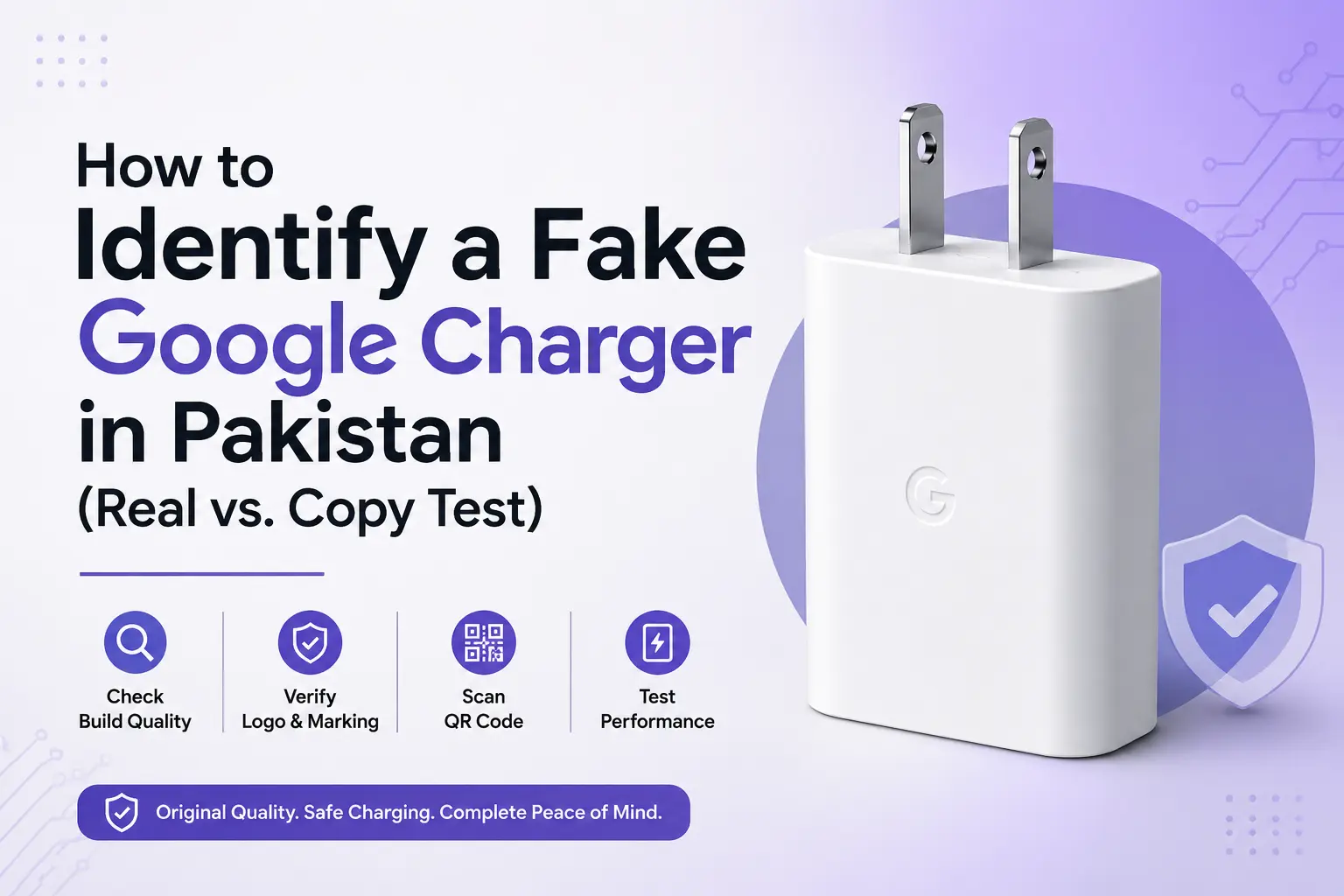
To identify a fake Google charger, perform a physical inspection: genuine chargers feature a matte finish with a debossed (indented) letter ‘G’, whereas fakes often have a glossy finish or mistakenly use a ‘C’. Additionally, original chargers are 20-40% heavier due to real copper components, stay moderately warm (35-42°C) during a 10-minute charge, and come in thick, sturdy cardboard packaging with a plastic tag.
Here is a complete, deep-dive guide to ensuring the Google 30W or 45W charger you are buying in Pakistan is 100% genuine.
Why Fake Google Chargers Are Extremely Dangerous
Counterfeit accessories are not just slow; they lack the fundamental safety architecture required to process electricity safely.
- Zero Thermal Management: Low-quality chargers are built with substandard components stuffed into a small housing. Because they lack thermal management circuitry, they fail to dissipate heat properly, causing the charger to become uncomfortably hot (above 55°C). This excessive heat severely shortens the lifespan of your gadget and can even start a fire.
- No Durability or Sealing: Genuine power bricks are sealed shut using ultrasonic welding, making them tough enough to withstand daily abuse. Poorly made chargers use flimsy housings, and a broken prong stuck in a wall outlet can expose life-threatening AC voltage.
- Internal Short Circuits: To make a hollow fake charger feel heavier, counterfeiters sometimes glue loose pieces of metal inside. If this glue loosens and the metal touches the internal electronics, it will cause a catastrophic short circuit.
7 Professional Tests to Spot a Fake Google Charger
Do not rely on the seller’s word. Before you plug a new adapter into your Pixel, run it through these seven verification tests.
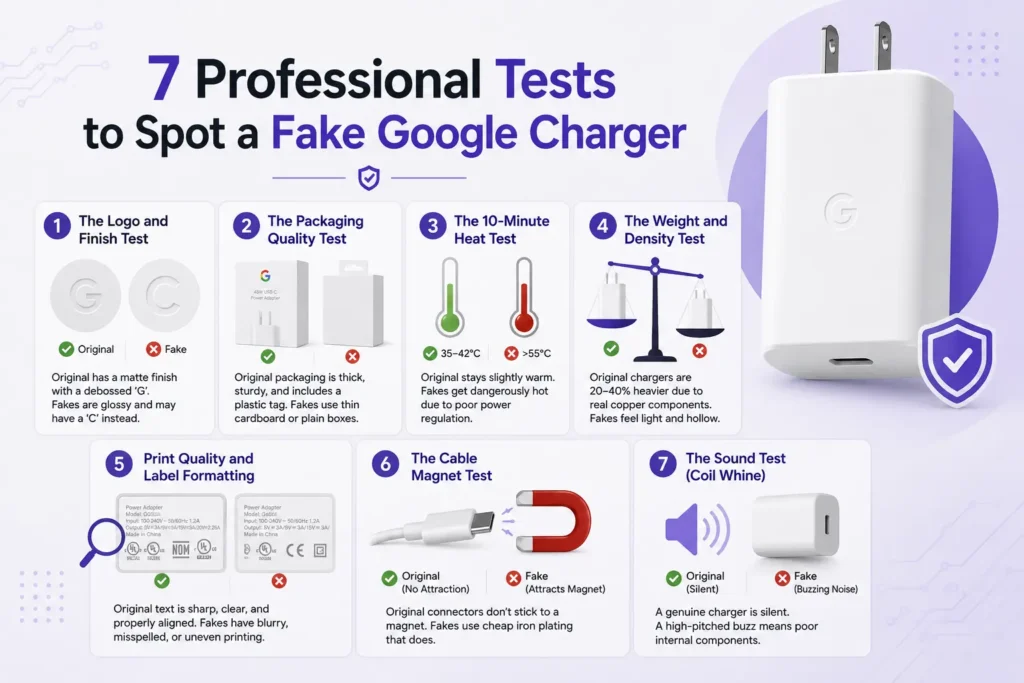
1. The Logo and Finish Test
Counterfeiters often miss the most basic design cues.
- The Original: A genuine Google charger will have a matte finish with a perfectly debossed (indented) letter ‘G’.
- The Fake: Counterfeits frequently use a high-gloss finish. In some audacious cases, the fake chargers mistakenly feature the letter ‘C’ instead of the Google ‘G’.
2. The Packaging Quality Test
If you are buying a “box-packed” charger, the cardboard will give away the truth. Authentic Google packaging is incredibly sturdy, constructed from thick cardboard, and includes a plastic tag on the top of the box. Conversely, counterfeit packaging uses thin, flimsy cardboard material, or sometimes the charger simply arrives in a plain white box.
3. The 10-Minute Heat Test
If you already own the charger, plug it into your phone and monitor the temperature for exactly 10 minutes.
- The Original: It will get slightly warm, maintaining a safe temperature of around 35-42°C.
- The Fake: It will quickly become dangerously hot (exceeding 55°C) because it does not have the microchips needed to regulate power flow. If it is too hot to comfortably touch, unplug it immediately.
4. The Weight and Density Test
Original chargers rely on real copper transformers and Japanese capacitors, making them 20-40% heavier than their fake counterparts. Fake chargers feel incredibly light and hollow because they use cheaper aluminum and generic Chinese components.
5. Print Quality and Label Formatting
Inspect the regulatory text printed on the plug side of the adapter. Original chargers feature clean text, clear branding, and neatly printed technical details. If the text looks blurry, uneven, misspelled, or has strange font spacing, the charger is not genuine.
6. The Cable Magnet Test
If your charger comes bundled with a Type-C cable, grab a standard household magnet. Authentic cable connectors are typically nickel or gold plated and will not stick to the magnet. Fake connectors use cheap iron plating, which will immediately attract the magnet.
7. The Sound Test (Coil Whine)
Plug the adapter into a quiet room. A well-made, brand-name charger is completely silent. If you hear a high-pitched buzzing noise coming from the brick, it means the internal transformer is physically vibrating due to poor fastening or low-quality dampening components.
The Real Cost of Buying a Fake
A counterfeit charger might save you a few thousand rupees upfront, but it is a guaranteed way to destroy a smartphone battery that costs ten times that amount to replace. Authentic Google devices are engineered with high-quality materials and are rigorously tested for safety before leaving the factory.
To protect your Pixel’s motherboard from WAPDA surges and overheating, always bypass unverified open-market stalls and source your tech directly from trusted platforms. Ensure your hardware is verified, perfectly sealed, and fully capable of delivering true PD fast-charging speeds safely.
Frequently Asked Questions
Are there serial numbers to verify Google chargers?
While some third-party brands offer scratch-off QR codes for verification, counterfeiters often print fake barcodes on replica Google boxes that lead nowhere. Your best verification method is checking the debossed ‘G’ logo and running the weight and heat tests.
Can a fake charger ruin my battery health?
Yes. Fake chargers do not manage heat properly and lack over-voltage protection circuits. This subjects your battery to excessive thermal stress, rapidly degrading its maximum capacity and potentially causing the battery cell to swell.
Why does my fake charger feel heavy?
Because consumers have learned to check the weight of electronics, counterfeiters now glue random pieces of metal inside the hollow plastic casing to mimic the weight of genuine components. If the charger feels heavy but rattles when you shake it, it is a fake
Buy Original Charger in Pakistan : Google 30w and Google 45w charger .
Source of the Blog
Google Support : Original vs fake Google charger
Google : Google Charger collection