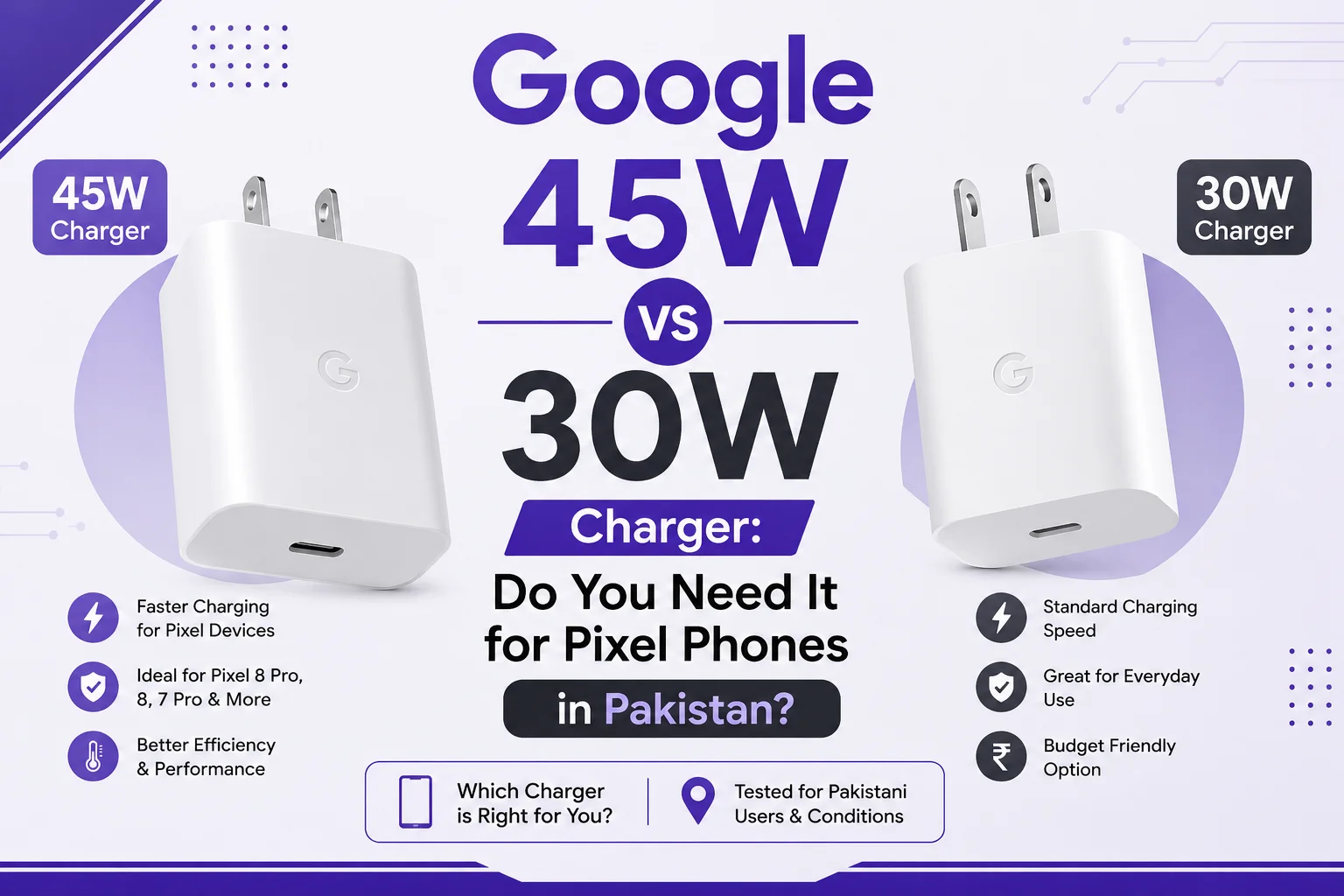
If you recently upgraded to a premium Google Pixel device, you are probably staring at the empty retail box realizing that the wall adapter is missing. You are now left with a critical decision that will dictate your daily routine: should you buy the Google 45W vs 30W Charger?
In Pakistan’s tech market, making the wrong choice doesn’t just mean slower top-ups; it can expose your expensive flagship motherboard to severe electrical risks and accelerated battery degradation. Many users assume that spending more on a 45W brick automatically doubles their charging speed. The truth is far more complicated, heavily relying on the specific Pixel variant you own, Programmable Power Supply (PPS) protocols, and the ambient temperature of your environment.
[Atomic Answer]
The choice between a Google 45W vs Google 30W Charger depends entirely on your specific phone model. If you own a Pixel 9 Pro XL or Pixel 10 Pro XL, the 45W adapter unlocks maximum speeds. For standard devices like the Pixel 9, 9 Pro, 10, or 10a, the hardware is capped at 27W to 30W, making the 30W charger the absolute maximum you need.
Why Pixel Fast Charging Confuses Everyone
Smartphone manufacturers have historically engaged in a numbers game. Brands like Xiaomi and Vivo push 120W speeds, leading consumers to believe that any premium smartphone should hit 100% in under 20 minutes. Google takes a drastically different, more conservative approach to battery longevity.
In local tech hubs, shopkeepers often push generic “65W” bricks, claiming they will supercharge a Pixel. This is electronically incorrect. Google devices operate on strict Power Delivery (PD) frameworks. Without specific voltage steps, your Pixel actively rejects the high-speed lane and defaults to a slow trickle charge.
At TechTouch.pk, we constantly field inquiries from buyers who spent premium rupees on third-party 65W chargers, only to find their Pixel 9 Pro takes over two hours to charge. The bottleneck is not the phone; it is the fundamental mismatch of electrical handshakes between the wall adapter and the device’s internal power management integrated circuit (PMIC). Let’s decode the actual science behind Google’s proprietary charging logic so you can invest in the right gear.
Google 45W vs 30W Charger: The Raw Specifications
To make an informed purchase, we must separate marketing claims from actual lithium-ion chemistry. Here is how Google segments its power delivery across its latest smartphone lineups.
The Google 30W Charger: The Baseline Standard
The original Google 30W PD Fast USB-C Charger is the undisputed sweet spot for the vast majority of the Pixel ecosystem. If you are holding a standard base model or a smaller “Pro” variant, this is the limit of what your hardware can physically absorb.
- Pixel 9 and 9 Pro: These devices hardware-cap their power intake at 27W.
- Pixel 10 and 10a: Recent technical upgrades bumped this intake slightly, allowing these devices to pull a maximum of 30W wired charging.
If you own any of these models, plugging them into a 45W adapter will yield absolutely zero speed increase. The phone’s software acts as a gatekeeper, instantly throttling the 45W flow down to 27W or 30W. You will have spent extra money on unused overhead capacity. The 30W brick will reliably push these phones from 0% to 50% in roughly 30 minutes, which is more than adequate for most daily workflows and university routines.
The Google 45W Charger: The Pro XL Powerhouse
The Google 45W PD Fast Charger was explicitly engineered for the “XL” class of devices. Google increased the physical size of the battery cells in these larger phones, allowing them to absorb higher voltages without risking thermal runaway.
- Pixel 9 Pro XL: This device requires a highly specific 18–21V Programmable Power Supply (PPS) protocol to unlock its advertised 37W peak charging speed.
- Pixel 10 Pro XL: Upgraded to support up to a genuine 45W wired charging rate, making it the fastest charging Pixel device to date.
For XL owners, the 45W adapter is not a luxury; it is a necessity if you want to bypass the agonizingly slow two-hour charging window. During laboratory testing, the 45W brick allowed the Pro XL series to hit a 70% charge in roughly 30 minutes. This massive burst of energy in the first half-hour is critical for professionals rushing to morning meetings or travelers topping up at airport lounges.
The PPS Protocol: Why Wattage Numbers Lie
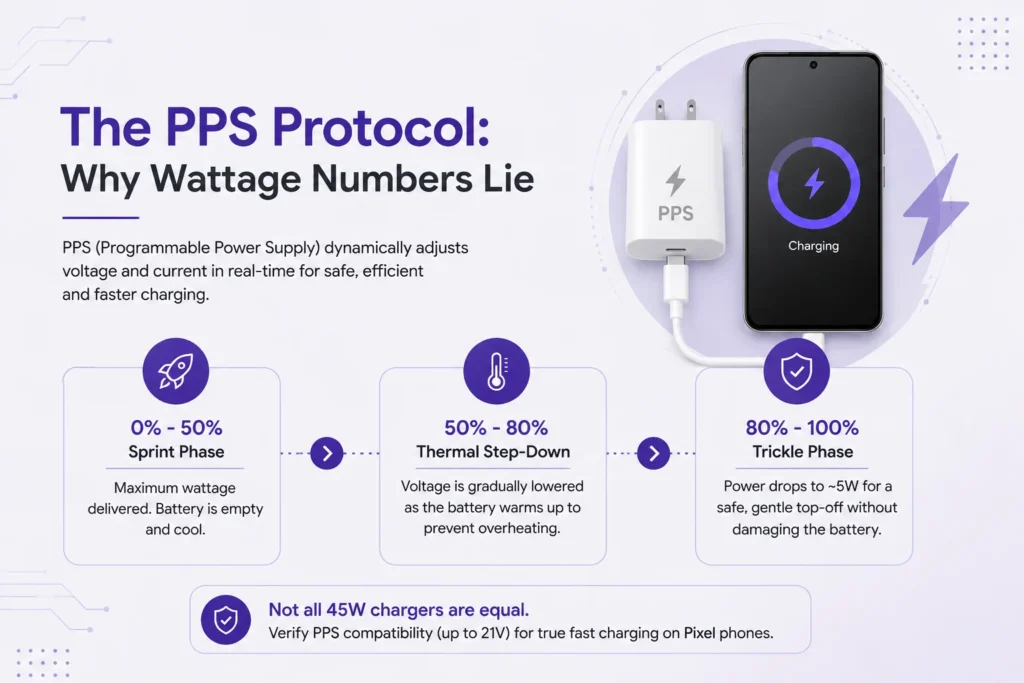
Understanding why a generic 45W laptop charger will not fast-charge your Pixel requires a deep dive into the USB-IF standards, specifically Programmable Power Supply (PPS).
Standard fast chargers use fixed voltage steps. When pushing power, the phone’s motherboard converts the voltage, generating heat. PPS changes this. A PPS-certified charger dynamically alters its voltage output in microscopic increments in real-time.
- The Sprint Phase (0% – 50%): The charger pumps maximum wattage because the battery is empty and cool.
- The Thermal Step-Down (50% – 80%): As the battery warms up, the Pixel instructs the PPS charger to slowly lower the voltage, keeping the device from overheating.
- The Trickle (80% – 100%): The charger drops to a mere 5W to safely top off the lithium layers without causing micro-swelling.
If you buy a cheap 45W charger without PPS up to 21V, your Pixel 9 Pro XL will forcefully reject the high-speed handshake and throttle down to a safe 27W or lower. You must verify PPS compatibility, not just the raw wattage number printed on the box.
The Cable Bottleneck: Why Your Wire Matters
You can purchase the most expensive, authentic Google wall adapter on the market, but if you connect it to your phone using a cheap gas-station wire, you will never see fast charging speeds. Power delivery is a two-part equation.
High wattage requires a high capacity for electrical current. Standard Type-C cables—the kind you typically find in budget accessory bins—are rated for a maximum of 3 Amps. The Google 45W charger, when pushing maximum power through PPS protocols, requires a robust cable capable of handling extreme current safely. If you attempt to force high wattage through a basic 3A cable, the wire’s internal resistance will cause it to heat up, creating a massive fire hazard.
To prevent this catastrophic failure, modern premium cables are equipped with an E-Marker identification chip embedded directly into the Type-C connector. When you plug your Pixel into the wall, the Google charger sends a digital ping to the cable’s E-Marker chip. If the chip responds correctly, verifying that the wire can handle the load, the charger authorizes the 37W or 45W output. If the cable lacks the chip or is damaged, the Google adapter instantly triggers a safety protocol, throttling the output down to a baseline 15W or 18W. Therefore, when upgrading to a premium power brick, you must also invest in a verified 5A-rated, E-Marked Type-C to Type-C cable.
WAPDA Surges, Summer Heat, and Battery Health
Using high-end tech accessories in Pakistan requires accounting for severe environmental and infrastructural hazards. Our local power grid is notoriously volatile.
Protecting the Logic Board from Voltage Spikes
Load shedding is a daily reality. When WAPDA power is restored, electrical lines suffer severe transient voltage spikes that travel down your cable into your phone. Authentic Google chargers use metal oxide varistors (MOVs) and isolation transformers to absorb line spikes, destroying their own fuse to save your phone. Cheap market clones lack these filters, acting as an open highway for destructive current.
The 40°C Thermal Limit Challenge
Lithium-ion batteries are extremely sensitive to ambient heat. During a peak Pakistani summer afternoon, room temperatures easily cross 40°C. Fast charging generates internal resistance heat. If you combine environmental heat with cheap, unregulated fast charging, your Pixel will hit its thermal limit almost instantly.
Google’s original PPS adapters combat this by monitoring the thermal load. If the ambient temperature is dangerously high, the charger intelligently steps down the power output to protect your battery’s long-term health capacity. This is why you might notice your phone charging slightly slower during the summer months—it is an intentional safety mechanism, not a hardware defect.
Original vs. Fake Google Chargers in the Local Market
The local e-commerce and retail landscape is flooded with master copies. These fake Google chargers are visually identical to the naked eye, replicating official retail boxes, security seals, and fonts perfectly. However, connecting a fake adapter to a flagship smartphone is a catastrophic financial risk.
Here is how you can physically verify the authenticity of your power gear:
| Inspection Checkpoint | Genuine Google Hardware | Fake / Counterfeit Replicas |
| Physical Weight | Dense and noticeably heavy due to internal cooling layers and thick copper sinks. | Hollow, light, or artificially weighted with internal glued iron blocks that rattle. |
| Logo Engraving | The ‘G’ logo is smoothly debossed (indented) with a premium matte finish. | The ‘G’ is often a glossy, surface-level print or sticker that chips off easily. |
| Port Alignment | The USB-C female port is perfectly centered with zero jagged plastic molding flash. | Crooked internal pins, uneven port cuts, and bright white plastic inserts. |
| Touchscreen Stability | Smooth scrolling and typing while plugged into the wall outlet. | “Ghost touches” where the screen glitches due to raw electromagnetic noise leakage. |
A fake adapter does not just charge slowly; it dumps dirty, unfiltered current directly into your device’s grounding frame. This causes the capacitive digitizer screen to jump erratically and accelerates the degradation of your battery health percentage.
Cross-Compatibility: Can You Charge iPhones and Samsung Devices?
A common concern for multi-device households in Pakistan is whether a dedicated Google charger will damage an Apple iPhone or a Samsung Galaxy. The short answer is no, and the reason lies in universal standardization.
Because both the Google 45W and 30W chargers strictly adhere to the USB Implementers Forum (USB-IF) Power Delivery standards, they are incredibly versatile.
- Samsung Compatibility: Samsung Galaxy devices, specifically the S-series and A-series, also utilize USB-PD and PPS protocols. A Google charger will successfully trigger fast charging on a compatible Samsung device.
- Apple iPhone Compatibility: Modern iPhones support USB-PD fast charging. Plugging an iPhone into the Google 30W brick will safely deliver the maximum 20W to 27W that Apple hardware allows, pushing the iPhone from 0% to 50% in roughly 30 minutes.
This cross-compatibility makes the authentic Google charging lineup an excellent investment for your household, allowing you to clear the clutter of multiple brand-specific adapters from your desk.
Which Charger Should You Actually Buy?
Deciding between the Google 45W vs 30W Charger is entirely a matter of hardware matching. Do not fall for the trap of thinking higher wattage is universally better for every device.
Buy the Google 30W PD Fast Charger If:
- You own a Pixel 9, Pixel 9 Pro, Pixel 10, or Pixel 10a.
- You predominantly charge your device overnight or while sitting at a dedicated office workspace.
- You want an ultra-compact, reliable brick that safely maximizes your specific phone’s hardware limits without overspending.
Buy the Google 30w charger in Pakistan
Buy the Google 45W PD Fast Charger If:
- You own the Pixel 9 Pro XL or the Pixel 10 Pro XL.
- You are a power user who constantly drains their battery and relies on 30-minute emergency charging windows to survive the day.
- You travel frequently and want a single, powerful adapter capable of charging your flagship phone, a tablet, and a lightweight laptop seamlessly.
To ensure your investment is protected, always pair your chosen adapter with a verified Type-C cable. Standard cheap cables will bottleneck even the best adapter down to basic speeds.
Buy the google 45w charger in Pakistan
Frequently Asked Questions
Will the Google 45W charger damage my Pixel 9 or Pixel 10?
No, it is completely safe. Modern Pixel smartphones use intelligent power delivery protocols. If you plug a 45W charger into a phone that only supports 27W or 30W, the phone will communicate with the adapter and only draw its maximum safe limit. It will not overcharge or overheat your battery.
Why is my Pixel charging slowly even with an original Google 45W charger?
Your Pixel may be thermally throttling. If the ambient room temperature is too hot, or if the battery exceeds 35°C, the phone will intentionally slow down the charging speed to protect the internal lithium cells. Additionally, ensure you are using a high-quality E-Marked cable; a standard cheap cable will prevent the charger from reaching its peak output.
Can I use a MacBook charger to fast-charge my Google Pixel?
Yes. While Apple chargers support standard USB-PD, older bricks often lack the 21V Programmable Power Supply (PPS) protocol required by the Pixel Pro XL series. Your Pixel will charge safely, but it may default to a standard 27W speed instead of its peak potential.
Content based on the following sources :
Gsmarena : Google Pixel 10
Phonearena : Google Pixel 10 Battery and Charging: All the official upgrades
Electronics.alibaba.com : How to Maximize Pixel 9 Pro XL Charging Speed: A Practical Guide
Androidcentral : How fast is the Google Pixel 10a charging speed?