You just spent two or three lakh rupees on a premium Apple device in Pakistan. You unbox it, admire the pristine screen, and then remember Apple left the charging brick out of the box. What happens next is a standard routine. You walk down to local hubs like Hall Road in Lahore, Saddar in Karachi, or Singapore Plaza in Rawalpindi. You ask the shopkeeper for a quick fix, and they slide a “99% original master copy” adapter across the counter for Rs. 800 or Rs. 1,500.
This single choice is where your hardware troubles begin. Pairing a high-end luxury smartphone with an unverified clone brick causes direct component strain. Our local power grid experiences constant load shedding variations and sudden phase fluctuations. If your wall adapter doesn’t possess commercial-grade isolation filters, that erratic current floods directly into your device.
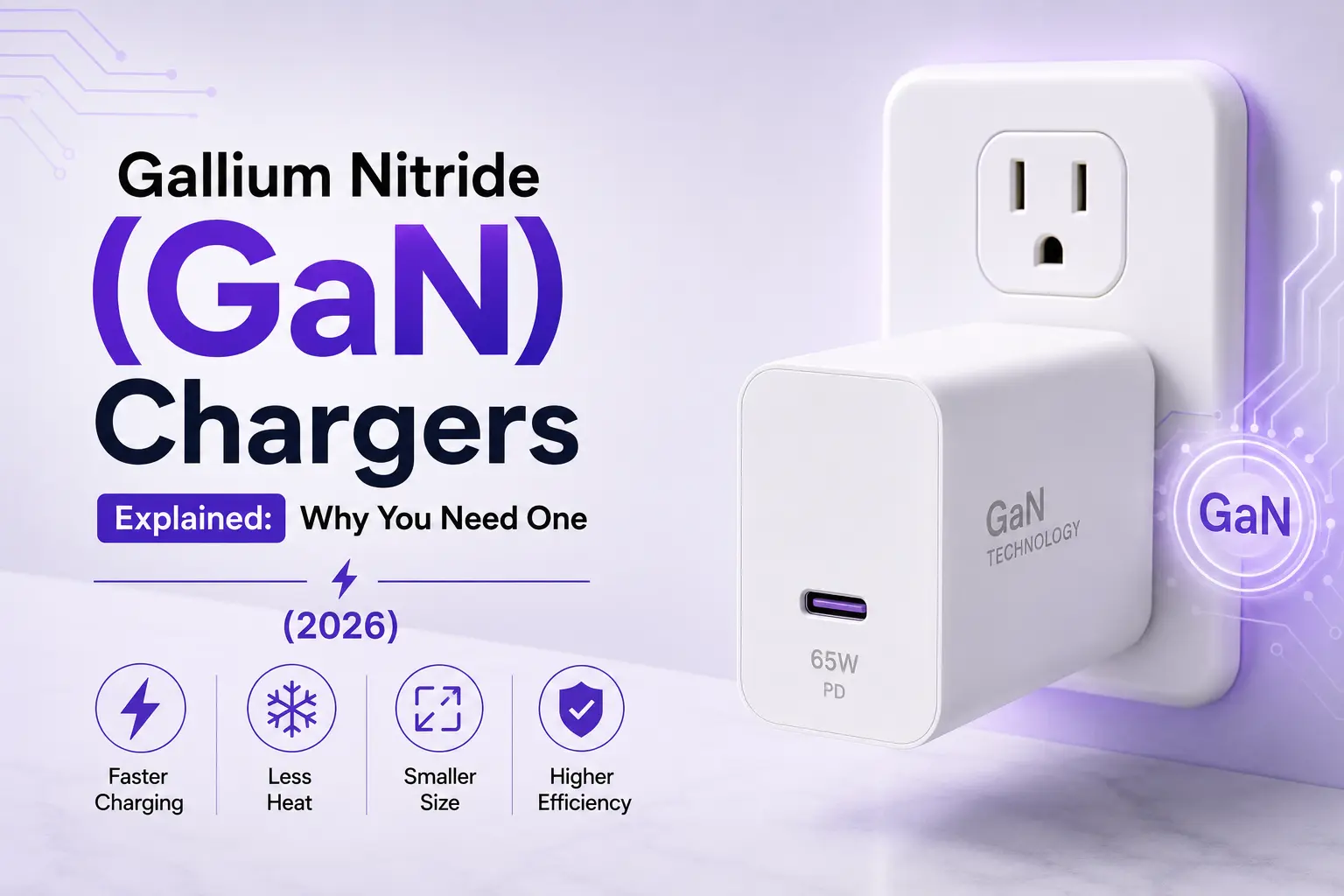
Investing in an original Anker charger for iPhone is not a luxury shortcut; it is a direct insurance policy for your phone’s logic board hardware. Anker builds power equipment using high-end Gallium Nitride (GaN) semiconductors that align perfectly with iOS power regulation protocols. If you want your maximum battery health percentage to stay stable after six months of daily top-ups, you need to understand the true cost of cheap power delivery.
The Master Copy Trick: What Local Mobile Markets Hide
Local shopkeepers rely on misleading labels like “A+ Grade,” “E-Commerce Overstock,” or “Company Copy.” These are fake tags used to clear bulk electronic junk.
Real customs documentation reveals that clone adapters completely bypass official regulatory testing. They enter local markets as undocumented components, packed into cheap plastic housings with counterfeit branding slapped on top. They are missing primary safety components like noise filters, grounding pins, and surge suppressors.
How Fake Adapters Degrade Battery Health
Unregulated Thermal Energy
Clone adapters dump raw current continuously without communicating with your phone’s internal battery indicators. This lack of handshake protocol forces the phone to work overtime trying to regulate the incoming voltage.
Cell Layer Breakdown
This continuous electrical pushing causes internal heat build-up. Excessive thermal loads bake the delicate lithium-ion layers inside the battery, leading to rapid capacity drops, swelling, and permanent energy drainage.
The Touchscreen Ghost Touch Test
Have you ever noticed your screen jumping or glitching while plugged in? You try to type a quick text, but the keyboard inputs random letters, or your social feed scrolls wildly on its own. This is known as “ghost touch.”
This happens because the cheap clone plug leaks massive electromagnetic noise directly through your charging cable. The electrical interference disrupts the sensitive digitizer screen panel on your phone. If that low-grade current is strong enough to scramble your display sensors, it is actively degrading the sensitive charging microchips deeper inside your phone’s chassis.
Why Buying an Original Anker Charger for iPhone Saves Your Motherboard
Our national power supply grid is highly unstable. When WAPDA power returns immediately after a blackout, the line carries an intense electrical surge.
Why do copy phone adapters burn out iPhone motherboards during voltage surges?
- Copy adapters lack surge suppression microchips and heavy internal transformers. When a WAPDA line surge hits your wall outlet, the fake brick allows the high-voltage spike to travel instantly down your charging cable. This burns out the iPhone’s critical U2 Tristar power management integrated circuit (IC), killing the phone instantly.
Technical Comparison: Internal Architecture
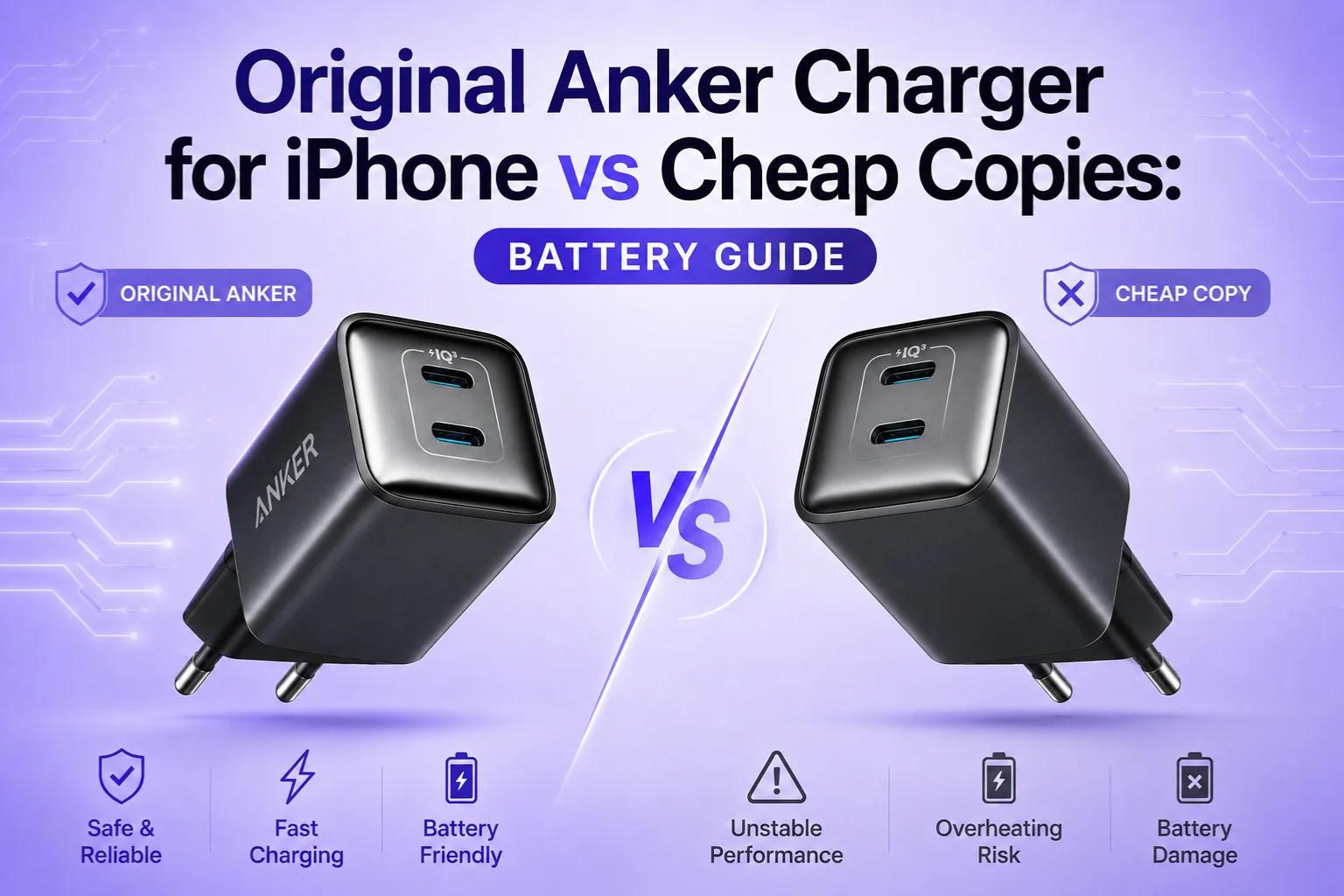
Pick up a market copy adapter and a premium GaN brick at the same time. The counterfeit feels hollow and light, almost like an empty plastic matchbox. It lacks weight because it leaves out essential filtering hardware.
Inside a clone adapter, you will find messy, hand-soldered green circuits, thin transformer coils, and zero structural insulation. Some copy factories even glue random iron blocks inside the plastic shell simply to trick buyers into thinking the adapter contains heavy, premium engineering.
Anker uses impact-resistant, high-density, flame-retardant polycarbonate cases. The inner components are automated-machine soldered, packed tightly, and insulated with commercial-grade thermal paste to dissipate operational heat evenly before it leaves the brick.
Easy-to-replicate comparison data highlighting the functional differences between authentic accessories and clone alternatives:
| Technical Specification | Genuine Anker Nano Series Hardware | Typical Market Copy/Counterfeit |
| Semiconductor Material | Gallium Nitride (GaN Systems Technology) | Traditional Silicon Base Components |
| Heat Control System | ActiveShield 2.0 Continuous Monitoring | None (Standard Fixed Thermal Fuse Only) |
| Power Delivery Compliance | Certified USB-PD / Apple PPS Protocol | Unregulated Static Voltage Flooding |
| Outer Chassis Construction | Flame-Retardant Heavy Polycarbonate | Low-Tier Thin Recycled Plastic |
| Internal Isolation Layer | Complete Copper Shielding Plates | Bare Circuit Board with Open Wires |
The Efficiency of Gallium Nitride (GaN) Tech
Traditional charging plugs use legacy silicon transistors. Silicon creates high resistance, meaning a notable portion of the electricity turns into raw heat instead of charging your phone. To make a high-power silicon charger, you need a giant, bulky plastic block that takes up massive wall space.
Anker swapped out old silicon for Gallium Nitride (GaN) crystals. GaN conducts electricity much faster and generates almost zero heat during energy transmission. This allows internal components to sit incredibly close together, allowing Anker to shrink the adapter down to a pocket-sized cube while keeping high wattage output safe.
Anker adds a specialized monitoring layer called ActiveShield 2.0. This technology samples the temperature of the wall charger over three million times a day. If your wall outlet arcs or your charging cable suffers a short circuit, the adapter lowers its output wattage instantly before the phone gets damaged.
Selecting Your Adapter From TechTouch.pk
The Anker 20W Charger: Reliable Daily Baseline
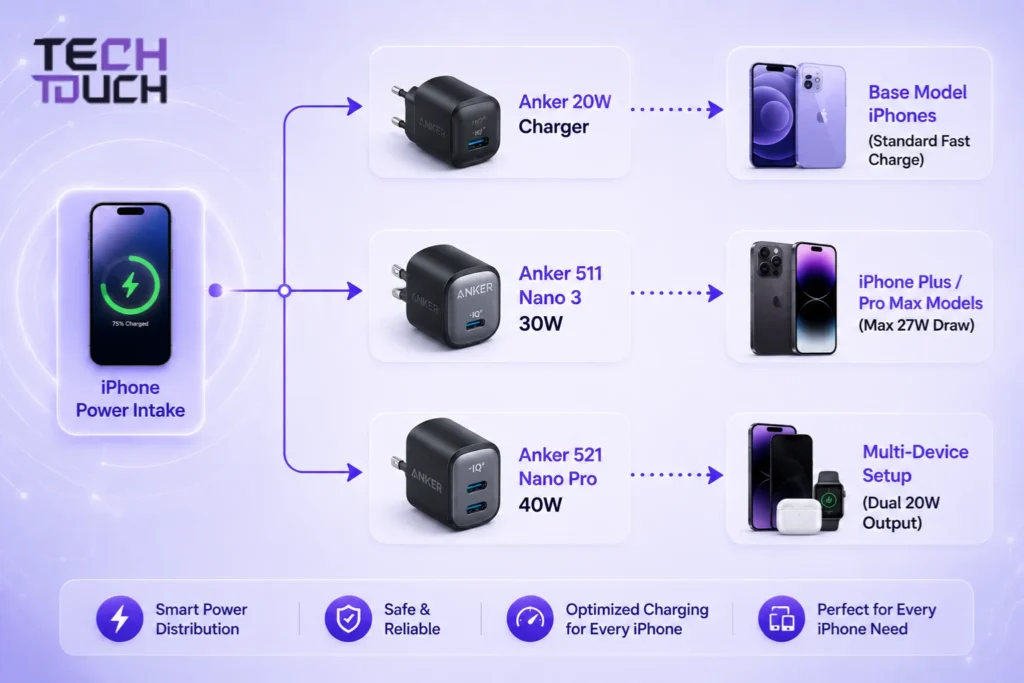
This is the standard option for base mobile setups. If you use a regular base device like the standard iPhone 12, 13, or 14, your device maxes out at a 20W input threshold. The authentic Anker 20W Charger provides exact baseline fast charging speed (reaching 50% in roughly 30 minutes) without making you overpay for unused overhead wattage.
The Anker 511 Charger (Nano 3 30W): Built for Pro Max Models
If you carry an iPhone Plus or Pro Max variant, your phone can pull up to 27W of power when low on battery. A standard 20W wall adapter will bottleneck your charging time.
The Anker 511 Charger (Nano 3 30W) is explicitly tuned to feed these high-tier batteries at their absolute hardware limit. It features a tiny layout with a folding plug layout, making it physically smaller than Apple’s classic, low-speed 5W wall block. It also handles tablets and can easily run a MacBook Air at your workspace.
The Anker 521 Nano Pro (40W USB-C GaN Fast Charger): Dual Port Workflow
For users running a dual-device lifestyle like an iPhone alongside an iPad or carrying two active phone lines—the Anker 521 Nano Pro 40W USB-C GaN Fast Charger provides the cleanest charging option.
It features two active USB-C output ports backed by dynamic energy-routing logic. Plug in a single phone, and it pushes the full 40W load. Plug in two devices together, and the chip splits the power down the middle into a clean 20W + 20W allocation. This keeps both devices fast-charging at their proper rates from one wall plug.
The Financial Math: Cheap Now vs. Expensive Later
A duplicate adapter costs you Rs. 1,000 upfront. Within four months of daily abuse, it drops your maximum health reading down into the low 80s. Your phone will start dropping frames and stuttering because iOS automatically throttles CPU performance to stop sudden power crashes.
Getting a genuine replacement battery inside Pakistan costs anywhere between Rs. 15,000 to Rs. 25,000 depending on your exact device generation. Even worse, you lose your phone’s original waterproof factory adhesive seals. If the clone adapter suffers a major component failure and fries your logic board, your entire investment is gone.
Using authentic charging gear removes these massive repair headaches completely. You buy the block once, and it keeps your current phone and future upgrades running safely for years. Protect your high-end smartphone, avoid market replica bricks, and secure your certified power gear directly from the official stock at TechTouch.pk.
FAQ
Can I use a 30W Anker charger for an iPhone that only requires 20W?
Yes, it is entirely safe. Modern iPhones use smart power delivery protocols to control power intake. The phone will communicate with the Anker 511 30W charger and only pull its maximum supported wattage, preventing any overcharging or electrical damage.
How can I verify if an Anker charger in Pakistan is original?
Original Anker chargers feature crisp, laser-etched serial numbers, thick pins, and heavy internal shielding that gives them a distinct weight. Counterfeit models feel light, have uneven seams, use cheap font prints, and often cause your touch screen to lag or glitch while plugged into the wall.
Why does my iPhone get hot when charging with cheap copy adapters?
Cheap copy adapters do not have intelligent power control microchips. They dump unregulated voltage into your phone and ignore rising battery temperatures. This forces the internal phone battery cell to overheat, causing rapid health degradation compared to an original GaN charger.