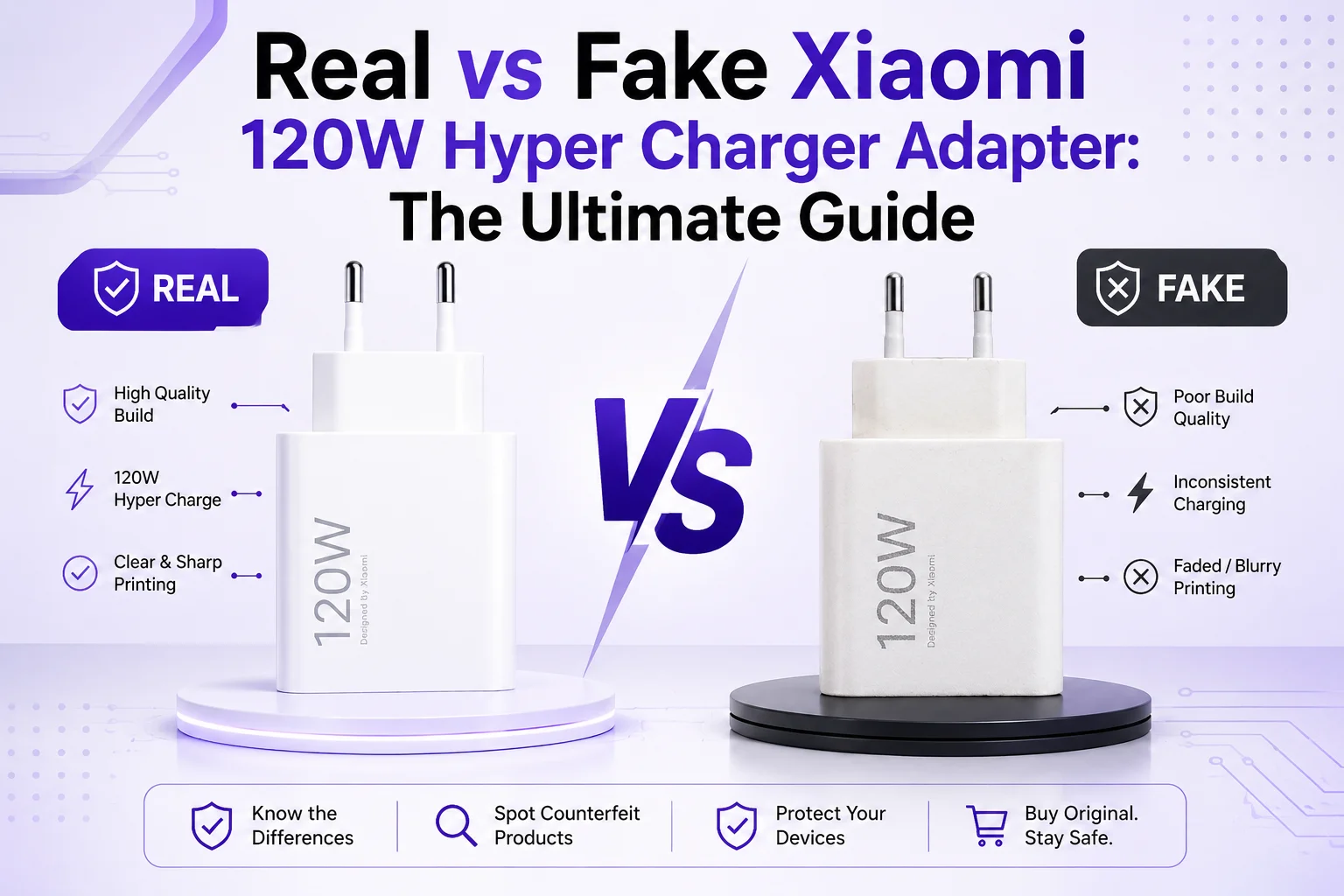
To identify an original Xiaomi 120W charger, check its exact weight and text. A genuine Xiaomi MDY-13-ED/EF 120W GaN charger weighs between 142g and 145g due to internal copper heatsinks, whereas fakes often weigh under 125g. Authentic units use Xiaomi’s proprietary “Mi Sans” font for the laser etching and feature a scannable QR code on the back that links to [mi.com/verify](https://mi.com/verify). Additionally, an original charger requires a verified 6A E-Marked Type-C cable with an orange internal tongue to trigger true “120W HyperCharge” speeds safely.
If you own a flagship Xiaomi device like the Xiaomi 13 Pro, 14 Ultra, or the POCO F4 GT, the 120W Hyper Charge capability is one of its biggest selling points. The ability to take a massive 5000mAh battery from completely dead to 100% in under 20 minutes changes how you use your phone.
However, because 120W adapters are expensive, the Pakistani mobile market has been flooded with high-tier counterfeits. Searching for an original Xiaomi 120w charger can feel like navigating a minefield. Many third-party sellers offer “OEM-style” chargers that look identical to the naked eye but lack the critical internal safety hardware.
At TechTouch.pk, we rigorously test our inventory. This guide will walk you through the exact technical and physical differences between a real Xiaomi 120W brick and a dangerous counterfeit, so you never risk frying your device.
Why a Fake 120W Charger is Extremely Dangerous
We are not talking about standard 15W or 25W charging here. Pushing 120 Watts of raw power (typically negotiated at 20 Volts and 6 Amps) into a lithium-ion battery requires incredibly precise voltage regulation.
An authentic Xiaomi charger uses Gallium Nitride (GaN) technology. GaN chips manage extreme electrical loads while keeping the physical brick relatively cool. Counterfeit manufacturers do not use GaN because it is expensive; instead, they use cheap, older silicon components packed into a hollow shell.
When you plug a fake 120W charger into your premium smartphone, three things happen:
- Voltage Drift: Genuine units hold a strict ±0.1V tolerance. Fakes drift wildly, pushing unstable voltage that permanently damages the motherboard’s power IC.
- Missing Thermal Throttling: A real Xiaomi charger actively communicates with your phone. If the ambient temperature hits 35°C, the charger intelligently drops its output to 60W. Fakes blindly pump electricity until internal components melt or catch fire.
- Spoofed UI: Some high-level fakes contain a hacked chip that forces your phone’s screen to display the “120W Max” animation, even though it is only trickling power at 20W.
5 Technical Checks to Identify an Original Xiaomi 120W Charger
Do not rely on the box it comes in—counterfeit packaging is easily replicated. To verify authenticity, you need to inspect the hardware itself.
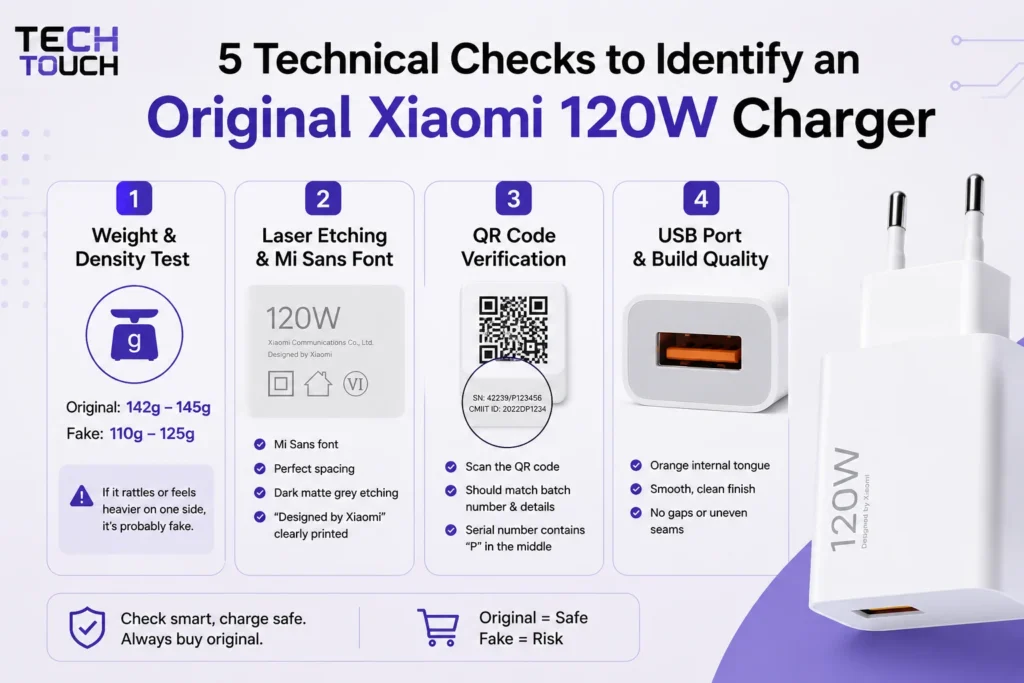
1. The Weight and Density Test
Because original GaN chargers are packed with advanced ceramic capacitors, high-frequency transformers, and heavy copper heatsinks wrapped in thermal paste, they are remarkably dense.
- Original Xiaomi 120W Weight: Exactly 142g to 145g (depending on the region’s plug variant).
- Fake Charger Weight: Usually between 110g and 125g.
Warning: Some counterfeiters have caught on to the weight test and have started gluing solid iron blocks or heavy “thermal putty” to the inside of the plastic shell. If a charger feels heavy but rattles when you shake it, or if it feels distinctly heavier on one side than the other, it is a fake.
2. The Laser Etching and “Mi Sans” Font
Turn the charger over and look at the tiny regulatory text printed on the plug side. Xiaomi uses a highly specific, proprietary font called Mi Sans for all its laser etching.
1.Check the Kerning (Spacing):
The original text is perfectly spaced. Fakes often use generic Arial or Helvetica fonts where the letters in “120W” are spaced too widely, or the text looks slightly blurred.
2.Check the Ink Quality:
Original printing is a dark, matte grey that is etched into the plastic. Fakes use bright white ink that sits on top of the plastic and can be scratched away with a coin or fingernail.
3.Check the Manufacturer Tag:
Genuine units will clearly state the manufacturer name (often “Designed by Xiaomi” or noting their specific factory partners). Fakes sometimes misspell “Xiaomi” or lack the dot over the letter “i”.
3. The QR Code Verification
Every authentic MDY-13-ED/EF charger includes a scannable QR code on the back label. When scanned, this code does not just take you to a generic website; it reveals the specific batch number, production date, and factory code.
The serial number embedded in an original QR code usually follows a strict alphanumeric format containing a “P” in the middle (e.g., ###P#####). If scanning the QR code returns a blank text string, takes you to an unverified website, or if the printed serial number does not match the scanned data, the charger is counterfeit.
4. The USB Port Seams
Look inside the USB-A port on the charging brick. Genuine Xiaomi 120W chargers feature an injection-molded port with an orange internal tongue. The plastic inside the port should be perfectly smooth, with no jagged edges (flash) from cheap molding processes. Furthermore, genuine Xiaomi chargers are sealed seamlessly around the middle if there is a massive, visible gap or uneven seam running along the sides of the brick, it is a replica.
The Cable: The Hidden Bottleneck of 120W Charging
You can buy a 100% original Xiaomi 120W brick, but if you pair it with the wrong cable, you will never see 120W speeds.
HyperCharge technology requires immense current specifically 6 Amps. A standard, high-quality laptop USB-C cable maxes out at 3 Amps or 5 Amps. Pushing 6 Amps through a 3A cable is a massive fire hazard.
To prevent this, Xiaomi places an E-Marker Chip and a 5.1kΩ ID resistor inside their official 6A cables (Model: PLM13ZM).
| Feature | Original Xiaomi 6A Cable (PLM13ZM) | Standard/Fake Type-C Cable |
| Amp Rating | 6A (Required for 120W) | 3A or 5A (Capped at 25W-65W) |
| Connector Color | Distinct Orange internals | Usually White or Black |
| E-Marker Chip | Yes (Validates safety) | No (Or heavily spoofed) |
| Thickness | Thick, rigid copper shielding | Thin, highly flexible |
When you plug in the charger, the power brick pings the cable’s E-Marker chip. If the chip responds correctly, the brick authorizes the 120W output, and your phone displays the “120W MAX” animation with the decimal point moving rapidly. If the cable is fake or damaged, the brick instantly throttles down to standard PD speeds (15W to 27W) to prevent melting the wire.
GaN vs. Silicon: The Thermal Reality Test
If you already own a charger and want to know if it is real, the final test is how it handles heat over time.
Because genuine Xiaomi adapters use Gallium Nitride, they are highly efficient at dissipating heat.
- The 5-Minute Test: Plug your phone in at 10% battery. During the first 5 to 8 minutes, the phone and the charger will get very warm—this is the peak 120W phase.
- The 60% Drop-off: Once your phone hits roughly 50% to 60%, a genuine charger will aggressively drop its wattage to around 60W, and then 30W. You will notice the physical brick beginning to cool down significantly even while the phone is still charging.
- The Fake Behavior: A counterfeit charger using cheap silicon cannot dynamically adjust its output curve properly. It will remain dangerously hot from 0% all the way to 100%. If your charger feels too hot to hold comfortably against your skin after 15 minutes, unplug it immediately.
Why You Should Never Compromise on Power
Using a cheap, unverified adapter on a ₹200,000+ smartphone is a gamble you will eventually lose. Counterfeit chargers drastically shorten battery lifespan by introducing unstable micro-currents that degrade lithium-ion cells over time. More importantly, they pose a severe fire risk to your home.
When you purchase the Xiaomi 120W Hyper Charger from TechTouch.pk, you are not just buying speed; you are buying the peace of mind that comes with authentic GaN technology, strict temperature controls, and verified E-Marker cables. We guarantee 100% originality so your device can charge exactly the way the manufacturer intended.
If your current adapter is failing the weight test, printing test, or thermal test outlined above, it is time to recycle it and upgrade to the real deal.
You can also checkout low power option like Xiaomi 33w charger or Xiaomi 67w charger .
Source of the blog :
- Electronics hub by Alibaba.com : What Xiaomi Charger Do I Need? Real Output, Compatibility & How to Spot Fakes
- Taobao.com : How to identify genuine xiaomi redmi original 6a 120w fast charging cable? 2025 anti-scam guide is here!
- Reddit : Is this a real charger
- Xiaomi.com : Xiaomi Global