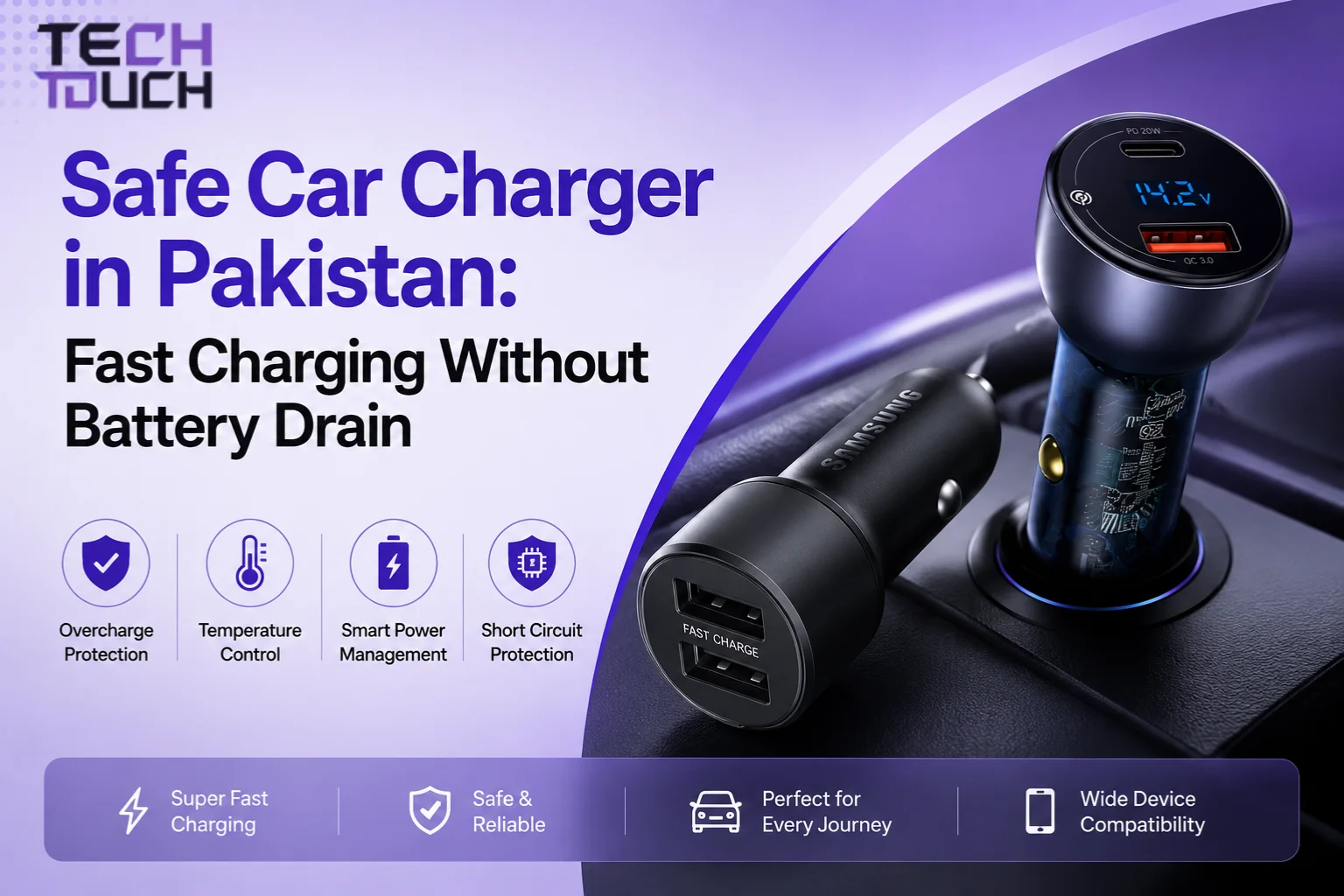
Whether you are stuck in a regular traffic jam on Shahrah-e-Faisal in Karachi, navigating the Canal Bank Road rush hour in Lahore, or commuting between Islamabad and Rawalpindi, your smartphone is always active. It handles maps, streams Bluetooth music, and manages work messages simultaneously. Naturally, your battery drops fast, forcing you to rely on a cigarette lighter adapter to top up your device while driving.
Most car owners plug their phones into cheap Rs. 300 plastic car plugs bought from local signal vendors or roadside stalls. This is an invitation to electronic hardware failure. Your vehicle’s electrical infrastructure is highly dynamic, fluctuating constantly based on engine RPMs and accessory loads. If your charging plug lacks intelligent filtering, it acts as a direct threat to your device.
Implementing a strategy for safe car charger in Pakistan isn’t just about speed; it is about protecting your flagship phone’s internal logic board and avoiding unnecessary strain on your car’s alternator system. If you want to charge your phone safely without getting stuck with a dead car battery or a fried smartphone power chip, you must understand how vehicular electricity works.
The Car Battery Drain Myth: Understanding Your Alternator
A common concern among local drivers is that using a high-wattage 45W or 65W car charger will prematurely drain or damage the vehicle’s main battery cell. This stems from a misunderstanding of automotive electrical networks.
When your vehicle’s engine is actively running, all onboard electronics including your audio unit, air conditioning fans, headlights, and cigarette lighter socket are powered directly by the engine’s alternator, not the battery. The alternator converts mechanical engine energy into clean direct current (DC) electricity, maintaining your car’s electrical needs while simultaneously recharging the main car battery.
A smartphone drawing 45 watts of power takes a microscopic fraction of what your alternator naturally produces. Whether you drive a 660cc Suzuki Alto or a 1.8L Honda Civic, your alternator handles fast chargers easily without straining your vehicle’s battery. The only real risk of battery drainage occurs if you leave high-power accessories plugged into an active cigarette socket while the engine is turned completely off, forcing the car to pull raw current from the static battery reserves.
The Ignition Spike: Where Cheap Chargers Destroy Phones
The genuine danger in automotive power setups occurs the exact fraction of a second you crank your car’s ignition. When you turn your car key or push the start button, the starter motor draws massive electrical current from your car battery to crank the engine pistons.
The moment the engine fires up, the alternator suddenly kicks in, frequently causing a brief but intense electrical voltage spike across the vehicle’s internal wiring framework. The voltage can instantly jump from a stable 12 Volts up to 15 or 16 Volts before the car’s internal voltage regulator can normalize the line.
Can using a cheap car charger short-circuit your smartphone during engine ignition?
Yes. Cheap car chargers lack step-down transient voltage suppressors. When you start your car engine with your phone plugged in, the sudden alternator voltage spike passes directly through the low-tier adapter into your phone cable, frying the device’s delicate power management IC (PMIC) and destroying your motherboard instantly.
To maintain stable power delivery, your adapter must feature dedicated over-current and over-voltage shielding layers that actively block these dirty engine starting spikes.
Physical and Electrical Benchmarks for Car Accessories
High-quality vehicular power accessories do not use cheap, lightweight plastic casings. They are engineered with aluminum alloy or heavy polycarbonate shells to manage structural heat effectively.
Inside a premium car adapter, you will find custom buck-boost converter circuits, thick solid-state capacitors, and dedicated grounding springs that prevent the adapter from slipping loose inside your lighter socket when driving over potholes or rough local roads.
Below is an easy-to-copy technical reference table highlighting the engineering differences between certified automotive charging accessories and low-grade market copy alternatives :
| Technical Benchmarks | Certified Premium Car Charger Hardware | Low-Grade Counterfeit/Copy Adapters |
| Enclosure Material | Fire-Retardant Aluminum Alloy / Heavy PC | Thin Recycled ABS Plastic (Melts Easily) |
| Voltage Intake Range | Wide 12V – 24V Support (Cars & Heavy Trucks) | Narrow, Unstable 12V Only (Blows Fuses) |
| Real-Time Diagnostics | Integrated LED Voltmeter / Dynamic Smart IC | None (Blind Continuous Power Flooding) |
| Socket Connection | Reinforced Spring Contacts (Anti-Slip Design) | Loose Metal Tabs (Disconnects on Bumps) |
| Protocol Integration | Certified USB-PD 3.0 / Programmable Power Supply | Legacy Fixed Voltage Line Output |
Selecting Your High-Tier Charging Hardware From TechTouch.pk
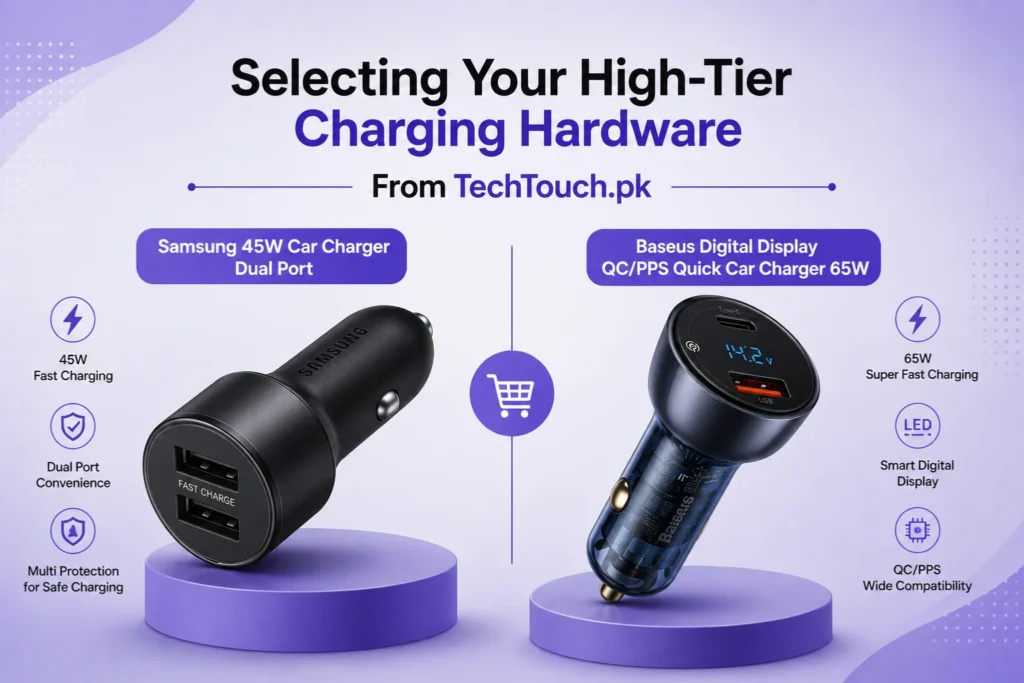
To keep your mobile accessories and car battery safe from irregular electrical fluctuations, you must select adapters featuring verified multi-layer protective hardware.
1. The Smartphone Standard: Samsung 45W Car Charger Dual Port
If your primary daily carry is a premium smartphone like a Samsung Galaxy Ultra or an Apple iPhone Pro Max, your device requires certified Power Delivery (PD) and Programmable Power Supply (PPS) protocols to hit maximum charging speeds.
The Samsung 45W Car Charger Dual Port is specifically optimized to meet this requirement. It features a main USB-C port that outputs a clean 45W stream, allowing compatible Samsung flagships to unlock “Super Fast Charging 2.0” right from your dashboard.
It also includes a secondary 15W USB-A port, allowing you to top up a dashcam or your passenger’s phone simultaneously without causing voltage drops or overheating your dashboard console panel.
2. The Power User Choice: Baseus Digital Display QC/PPS Quick Car Charger 65W
For freelancers, business professionals, or anyone who needs to run a MacBook Air, a high-end tablet, or multiple flagships from their dashboard socket, raw power is necessary.
The Baseus Digital Display QC/PPS Quick Car Charger 65W Output provides exceptional utility for heavy power setups. It outputs a massive 65W block from its primary Type-C port, giving you enough energy to charge a laptop at highway speeds.
The standout feature is its integrated digital LED voltmeter screen. This diagnostic display monitors your car’s real-time battery and alternator voltage output. When your engine is off, it shows your static battery health status; when you start driving, it shifts to verify if your alternator is outputting a healthy 13.8V to 14.4V stream, giving you early warning of any potential car battery failures.
When you see this logo of TouchTouch.pk you do not need to worry just buy it if you not satisfy with the product ship it back .
The Extreme Thermal Factor in Pakistan
Local climate conditions present a notable challenge for car charging safety. When your vehicle sits parked under direct sunlight during a 45°C summer day in Punjab or Sindh, interior cabin temperatures can cross 60°C.
Plugging a phone into a charger inside a hot cabin creates compounding thermal stress. Both your phone’s battery and the charger’s internal circuits generate heat through electrical resistance. Premium chargers from Anker, Samsung, and Baseus feature thermal throttling sensors. If the ambient dashboard temperature climbs too high, these smart adapters automatically scale back charging speeds to keep your phone from overheating.
Cheap clone plugs lack these thermal boundaries : they will continue to dump current into an already hot phone, permanently reducing your maximum battery health capacity or causing the internal battery cell to swell over time.
Simple Rules for Healthy In-Car Power Habits
- The Engine First Habit: Always turn on your vehicle’s engine first, and wait for the dashboard console lights to settle before connecting your charging cable to your smartphone. This keeps your phone completely safe from dirty ignition power surges.
- Disconnect When Parking: When you arrive at your destination and turn off your car’s engine, unplug your phone and remove your high-power adapter from the lighter socket if your vehicle keeps the port live when turned off, preventing slow background battery drain.
- Keep Ports Clean: Periodically check the interior of your car’s lighter socket. Dust, lint, or loose coins falling inside can cause short circuits that blow your vehicle’s interior accessory fuse.
Protect your expensive smartphone motherboard, monitor your vehicle’s alternator health, and buy original premium power gear directly from the official stock at TechTouch.pk.
FAQ
Is it safe to leave a car charger plugged into the lighter socket permanently?
If your vehicle completely cuts power to the lighter socket when the key is removed (like most modern Japanese and local cars), it is entirely safe. However, if you drive an older vehicle where the cigarette port remains powered while parked, leaving an adapter inside can cause a slow background power draw that drops your car battery level over a long weekend.
Why does my phone charge slowly or stop charging when using a car adapter?
This usually occurs due to thermal protection limits. If your dashboard gets too hot from direct sunlight or the car charger lacks proper heat sinks, either your phone or the adapter will automatically scale back energy transmission to a slow trickle charge to keep components from melting.
Can a 65W Baseus car charger damage a phone that only supports 20W charging?
No. Power delivery relies on smart negotiation protocols. The Baseus 65W adapter communicates with your device’s internal power management chip to supply the exact wattage your phone demands. It will scale down to 20W or 15W automatically, ensuring completely safe power delivery.

One Response
Very Informative blog